We couldn’t find a house plan that was “perfect” for us. And God knows we tried. I looked at thousands of house plans in books and online. I’m not exaggerating. I know it was thousands.
There were some that were “close” but nothing “just right.” Call me Goldilocks. I wasn’t finding my “just right.”
So when a family friend recommended a local draftsman, we jumped at the chance to design our own house. (You can check out the full process and plans here.)
And as we designed the home, we also needed to have a good handle on how it would be constructed. Since Ryan and our dream team will be constructing most of this themselves. It was amazing how many (seemingly) tiny little design decisions impacting the overall build process.
The first part of this was the joists/trusses – something I knew nothing about before. I still know very little, but Ryan briefed me on it so I could write a post.
You’re welcome.
Spoiler: We chose to build our house using floor trusses. And the first floor trusses are installed and so very pretty.
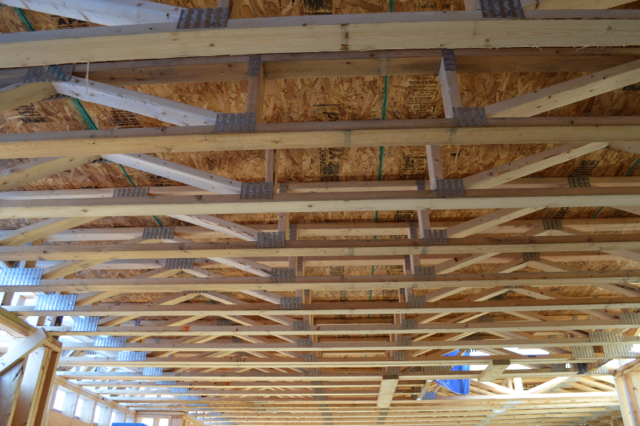
In case you are curious about the different type of options when building a house, here’s a lay(wo)man’s low-down:
Floor joists are traditional wood joists.
built from traditional 2x12s
Pros:
- Cheaper.
- More common/traditional.
Cons:
- Not as strong – won’t span as far apart – this means you’ll have to build a wall beneath them in some areas for structural integrity.
- You’ll need to to drill/cut them to run plumbing/heating/AC/electricity.
Wood I beam joist
engineered of plywood and 2x4s
Pros:
- Span longer distances than traditional joists, removing the need for walls in some areas.
- Lighter weight.
- Stronger than traditional joists.
- Wider nailing surface (making the building process easier)
Cons:
- Not as readily available – they need to be special ordered.
- Slightly more expensive than traditional floor joists.
- Need to drill for utilities.
Floor truss
Looks almost a wood web, connected with metal plates
Pros:
- Designed to hold weight in longer spans, meaning less walls are necessary.
- The strongest option.
- Spans the farthest distance without structural walls.
- No need to drill out for utilities.
- Wider nailing surface.
- Very customizable (our trusses were designed and ordered to specifically account for the size of our house and the utilities and ductwork).
- The design speeds the process of ductwork and other utilities.
Cons:
- Most expensive option.
- Heavier weight than ibeam joists.
- Need to special order floor trusses, which requires a longer lead time.
So that’s a little of what went into our decision to use floor trusses. And here’s how they look from the side.
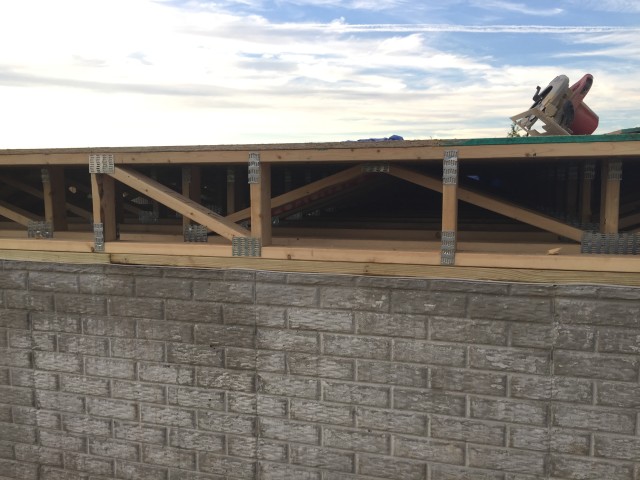
We hope the floor trusses will make the process easier down the line – running plumbing and ductwork and electricity through the spacing. But since the trusses are wider that other (more traditional) options, it did cause changes in the specs on the floor plan. Our floor plans account for this change.
Here’s a few more pictures of our progress in the past week. The concrete went into the basement and looks great. Then Ryan, our dads and my brother (who will henceforth be referred to as our dream team), installed the floor trusses on top of the basement walls.
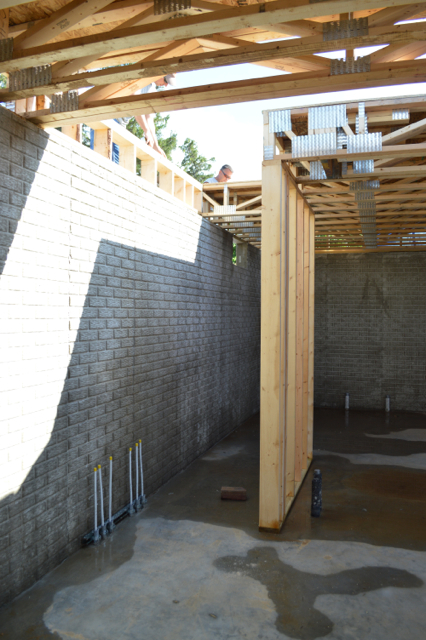
That also involved building the basement walls for the bathroom and the staircase. Check out those beautiful windows. Love. The pugs love them, too.
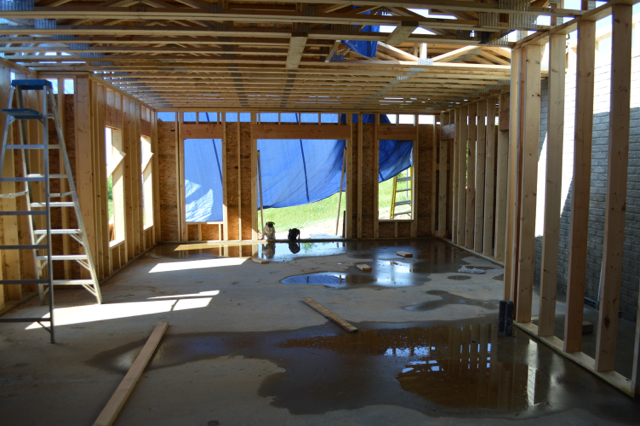
The rain and wind will not stop. So we’ve been using some giant tarps which has helped.
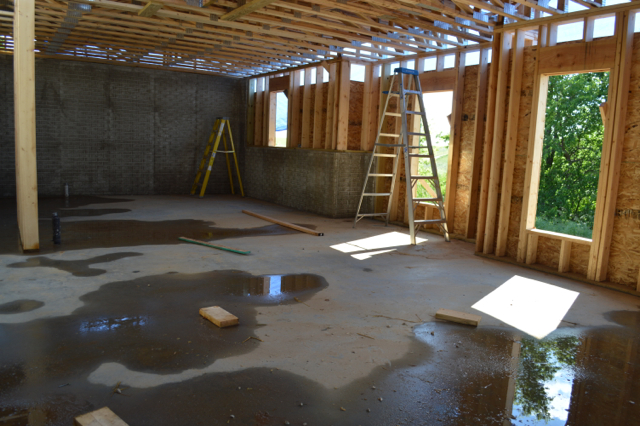
And the sheeting on the first floor helps, too.
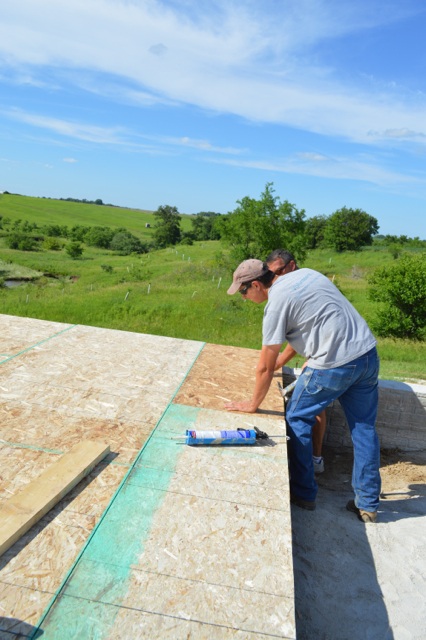
There were some setbacks this week but I’ll talk about those later.
Let’s focus on the positive. TRUSSES. FLOORS. CONCRETE.
We are considering using floor trusses for our new home. Our design calls for 24 foot spans with no load bearing walls between them. How long are your biggest spans?
20 feet
Awesome. Thanks. There are a lot of similarities between our project and yours. We love the blog!
Nice, like following your blog. The one thing (CON) you forgot to consider with Floor truss’ vs traditional joists is that they are much weaker in a fire situation and will collapse long before a traditional floor joist will.
Alex- this is actually not true of trusses. I just did some checking to confirm. But it is true of i-beams. Maybe that’s what you are thinking?
Much worse for i-Beams due to the OSB, however it is true of the truss systems due to the multiple voids and overall less material which weakens quicker. The lower cord is what usually gives out first causing the whole truss to fail. I am a NY fire fighter so I have some experience with this.
I think it’s Goldilocks who was looking for the just right thing. Regardless my mind is blown with your building knowledge. I’m always trying to look back and reverse my build when I read and am at a loss here. We had a slab foundation, so I don’t know if this applied to us. However we do have an upstairs, so maybe??? Help me understand what’s already happened at my house Kim!?!?! 🙂
trusses vs. joists! things I would NEVER know if it weren’t for Kim!
yay for progress. I LOVED learning all this new stuff about joists and trusses. Awesome. Are the trusses taller than 12 inches? how far are they spaced apart in the installation?
Those windows look very dreamy!!
The trusses are 14 inches tall and 16 inches apart for the most part. There are a few variances in spacing based on the plan.
Thanks for the comment!